Why I Don't Write On Scripts
May 12, 2026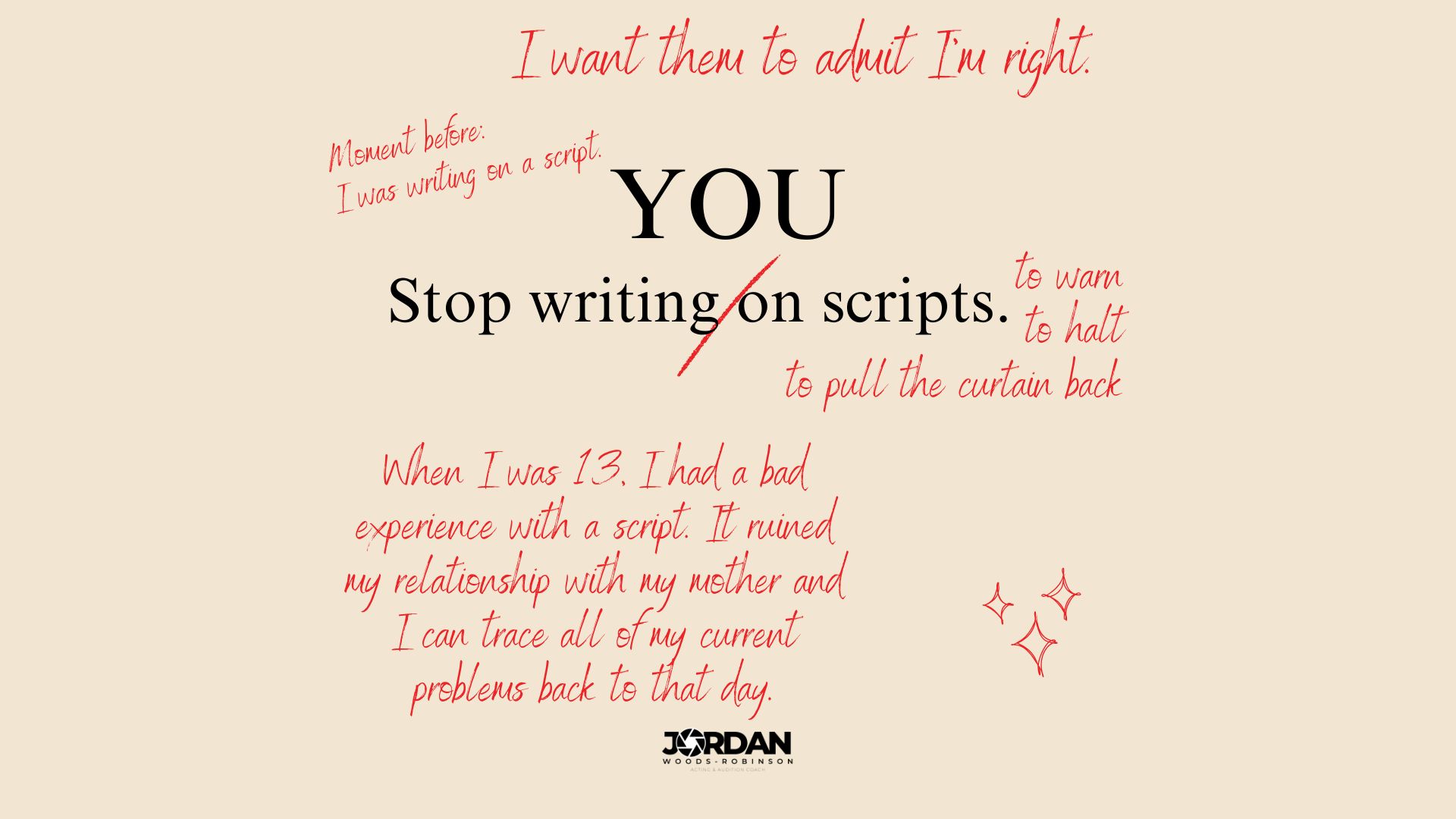
Here’s something I champion that often makes other acting folks skeptical: I don’t write on scripts. And I don’t encourage my actors to write on them either.
Let me explain.
In theatre, a marked-up script is often a journal. Not a bible. You rehearse for weeks, and between rehearsals you’ve got big gaps of time. The script becomes a place to preserve discoveries so you don’t lose ground before the next session. It’s a map of where you’ve been and a breadcrumb trail to follow when you return.
But in Film and TV? It’s different. We rehearse in front of the camera. Every take is an exploration. Every reset is another chance to see what lives in the moment. There’s no “waiting until next week.” You’re discovering right now, and the evidence lives in your partner and the environment around you, not in your margin notes.
The Trap of the Page
Here’s the largest problem I find when an actor has turned their script into a graffiti wall: it often locks them in. The page becomes the boss. Suddenly, instead of playing the scene, they’re “checking their homework.”
The work is often mechanical and/or immalleable. It’s living in the brain and the brain wants to be in control.
I call this living in the scrolling PDF. It scrolls behind the eyes like a projector at a movie theater. You’re tracking your notes instead of your impulses. You’re relying on the safety net of “what you planned” rather than discovering what’s actually happening.
Acting Belongs in the Body
Stanislavski, Meisner, Adler, Hagen, Chekhov... they all agree that the story lives in the body. In your breath. In your muscles. In physical action.
When the body leads in action, it has opportunities to encounter real obstacles and, thus, send real surprises to the brain.
Screenplays are blueprints. They’re designed to come alive through people, in bodies, in environments. The structure is revealed when it’s pulled off the page.
That’s why my goal is always to get actors off the page as quickly as possible. The sooner the script lives in your body and in the space around you, the sooner you stop “thinking about acting” and start living inside the scene.
So What Do I Do Instead?
There’s no 1 way I do this. Just like many other things in life, our intuition is often the most important tool. So I prefer for intuition to guide me, as opposed to being muted by a step-by-step process.
What do you think is interesting? Start there.
With that said, here are some bullet points to consider.
- I print it off before I read it for the first time. Every time. It’s different to have a tactile connection with the text rather than seeing it on a digital screen.
- I watch it play out as an audience member. I don’t cast myself in it... I watch the whole thing come together.
- I read through it 3, 5, 10, 20 times (depending on how quickly the next step comes around) until I could put the page down and tell someone the story/beats of the scene without referencing the page.
- I put the script somewhere and turn it over, face down. Then I get on my feet and start to stumble through the scene in my own words. (Why in my own words? Because I’m not seeking memorization at this point... I’m seeking understanding.)
- (note about this stage... sometimes I don’t want to work. And that leads me to standing in a room, silent and still, for minutes sometimes before I open my mouth. But then, inevitably, some idea or impulse will hit and I’ll be thrust into the text.)
- Next, I aim for everything I do after this to be out loud. Why? Because if I find the words of the text and have them bounce off these walls, I am now finding a real-world association with the text. I have a real life-based memory encompassed around this text which pulls it off the page and puts it into the world around me.
- The same with everything else I say. If I paraphrase something but it feels truthful, I have just introduced subtext into the world around me. If I mess up and lose my spot, and say to the room, “Crap. What happens next? I have no idea what happens next. *You* just said XYZ... Oh! I remember now...”
- Same thing with actions. I’ll find myself finding physical gestures and actions in the room. “What am I doing here? I’m scraping you; I’m holding you; I’m gouging you; I’m...”
- Since everything is all out loud, I find I am replacing the “scrolling PDF” with so many other data points to call back to... the blue walls; the light through the window; the dust I noticed on the ceiling fan; the lunch I was looking forward to.
In my experience, this play in the room does 3 things simultaneously:
1) It gets me on my feet before I’m “memorized.” Thus I’m prioritizing the body over the brain.
2) It fills in *tons* of “subtext” for me. If I’m free to say whatever I want while I figure this text out, I’m finding layers underneath the text.
3) It puts the play in the room, as opposed to on the page. I return to the page when I need it but it’s not what is calling the shots.
So no, I don’t write on scripts. I let the script serve its purpose, then I set it down and let my body take the lead. Because that’s where the imagination comes alive and that’s where the work stops being “acting” and starts being living.
See you in the trenches.
-J
SUBSCRIBE FOR WEEKLY MUSINGS
I'll deliver it right to your inbox... just tell me where to send it!
No Spam, only love.