Stop Using Beats
May 12, 2026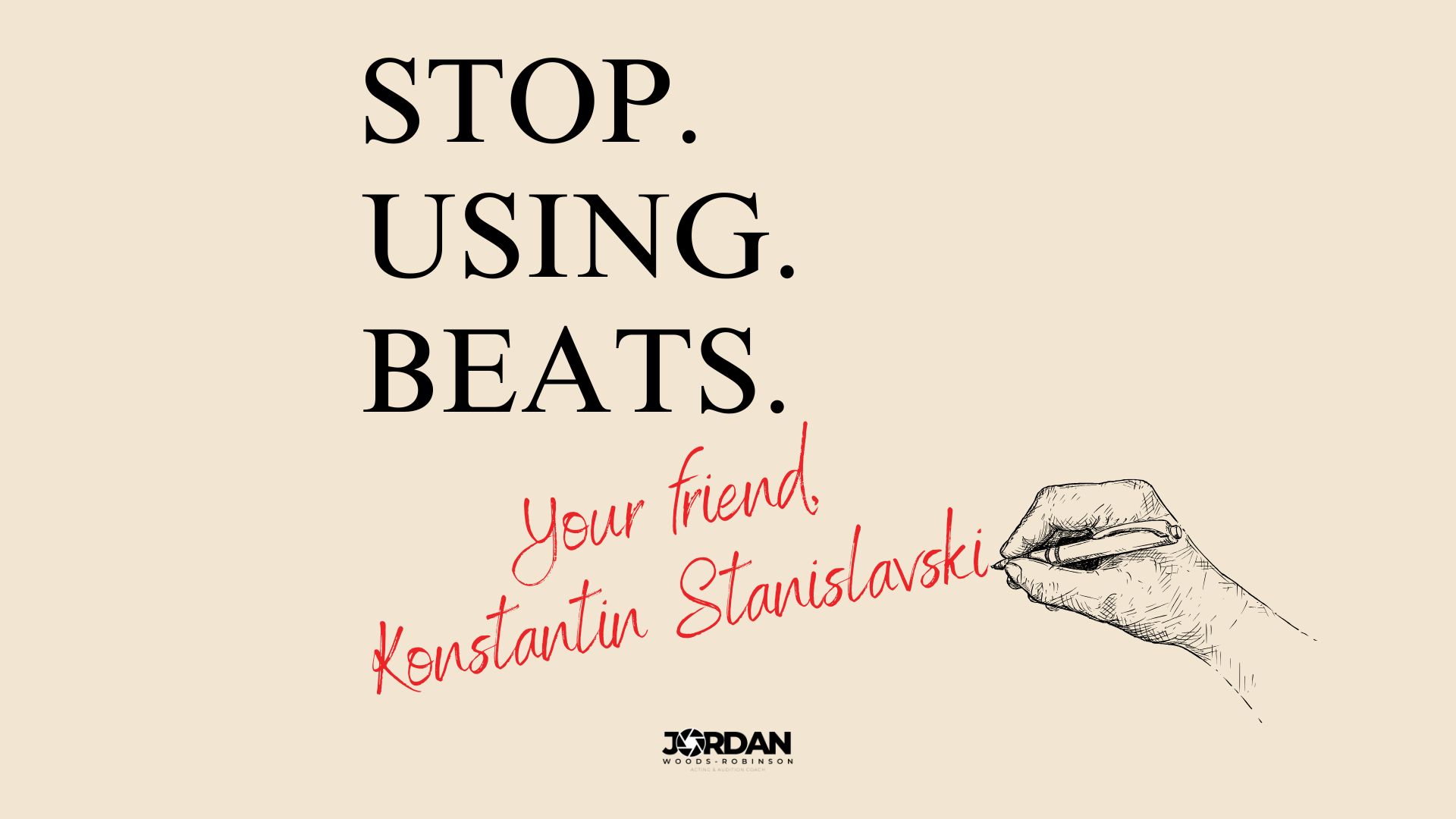
Did you know that a “beat” is most likely an incorrect translation from Stanislavski’s teachings?
How many times have you been told to find the beats... mark the beats...
And how many times have you wondered if a beat is a pause or a silence or a shift in the scene?
What Stanislavski *actually* wrote about was a “kusok.” Russian for a “slice.” A “piece.”
A... BIT.
Now say “bit” out loud with a Russian accent. I’ll wait.
And that, my friends, is most likely how the American Theatre Philosophers started to teach “beats.”
But what the living hell is a “beat?” Why does everyone have a different example? Why do writers, actors, and directors have different interpretations sometimes as to what a beat is?
Instead, think of it like a *bit*. A *bit* of the scene. Several *bits* of the scene live within the scene. And each *bit* is a standalone section of the scene.
One of my favorite things to ask actors when we’re working on a scene: “Where should the scene end? When could you walk away? Why do you choose to stay?”
What I’m really asking is... “Where are the bits?”
See, the *actor* knows that the scene continues. We know that Scene 1 is two pages and Scene 3 is four pages. We know that we have a nice moment planned near the end. We know about the moment after and the arc and the blah blah blah.
But the character has the freedom to leave at any minute. Is the conversation too hard? Walk away. Are you not going to get what you need? Leave. Are you being forced out? Stop fighting.
When we revisit Stanislavski’s “beats” and realize that it was originally mistranslated and should actually be something closer to “bits,” we see how that offers more specificity to the scene.
This scene is a series of smaller scenes. Each of these smaller scenes (or bits) has the opportunity to be the end of the conversation. It has the opportunity to be the end of the fight.
We should be living bit by bit, not scene by scene.
When you get to that crushing blow, expect it to land. When it doesn’t have the affect you wanted, you have to CHOOSE to re-enter the conversation with a new approach. Otherwise, the scene could absolutely end right there.
Each bit has its own heart beat (pardon the pun). It’s own life. It could be a standalone scene. It could have its own moments before and after.
And each bit has to be drastically different from the bit before it... otherwise, it’s not its own bit. It’s just a continuation of something you already did.
So next time you look at some text, find the bits. How many bits live within this scene? Where does one bit end and another bit begin?
And that is when you will be able to dig more deeply into what you’re doing and why.
-J
SUBSCRIBE FOR WEEKLY MUSINGS
I'll deliver it right to your inbox... just tell me where to send it!
No Spam, only love.